






Google is deepening its collaboration with the Singapore Government to strengthen national cybersecurity and protect residents from digital threats, including online scams, through two new artificial intelligence initiatives announced on the sidelines of Singapore International Cyber Week (SICW) 2026.

The partnerships will give Singapore access to Google’s advanced cyber defence technologies through its Fairwind Programme and see GovTech Singapore work with Google DeepMind to develop an AI model that detects potential scams directly on Android devices while preserving user privacy.
Under the Fairwind Programme, Singapore will gain access to Google’s advanced cybersecurity tools, including its Gemini 4 Argon model and CodeMender harness. The technologies are designed to help cybersecurity teams identify vulnerabilities, verify potential weaknesses and develop fixes at scale.
Google said the tools could enable defenders to generate verified, deployment ready software patches in minutes rather than spending weeks manually addressing vulnerabilities. The patches can be produced within an organisation’s secure cloud environment, giving teams an opportunity to resolve weaknesses before they are exploited.
The initiative aims to strengthen the protection of essential systems and services against cyberattacks and operational disruptions by allowing organisations to respond to security risks more quickly.
The second initiative focuses on detecting scams in real time through an AI model developed by Google DeepMind and the Government Technology Agency of Singapore, also known as GovTech Singapore.
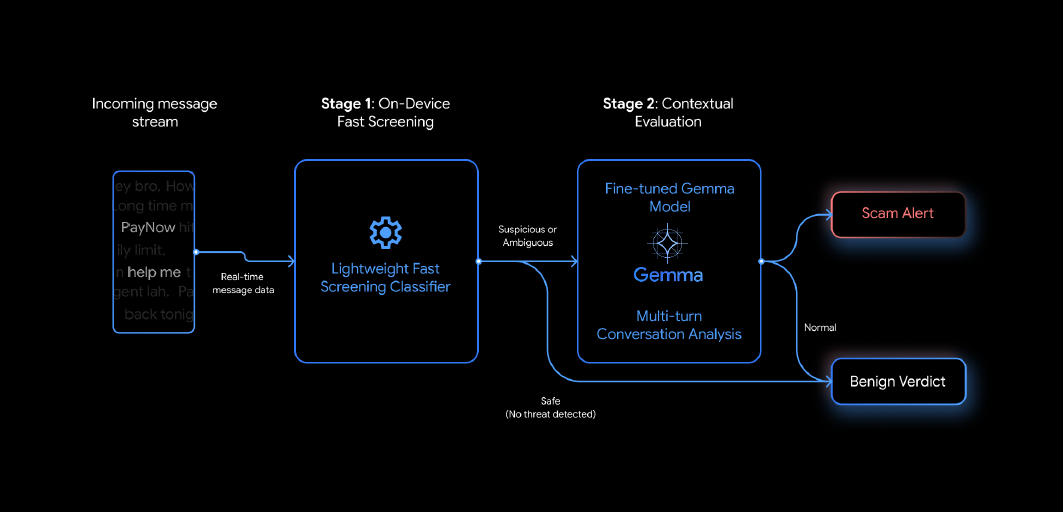
Unlike conventional threat detection systems that rely on scanning messages through cloud servers, the proposed model analyses conversations directly on a user’s device. This approach is designed to address the challenges of detecting scams on messaging platforms that use end to end encryption, where private conversations cannot be routinely inspected by external servers.
The model uses lightweight Gemma AI models fine-tuned on local scam narratives. These include impersonation attempts involving public institutions, banks and local figures, as well as emerging regional scam tactics.
The system is designed to recognise conversational patterns associated with social engineering, including structured messages and high-pressure tactics commonly used by scammers. Google said the model will undergo continuous training to help it adapt to changing scam methods and distinguish suspicious interactions from ordinary conversations.
When a potential scam is detected, the system can display a warning directly on the user’s screen, encouraging them to pause and exercise caution before sharing sensitive information, revealing account credentials or transferring money.
By processing conversations locally instead of sending message content to external cloud servers, the model aims to provide faster detection while keeping private chat interactions on the device.
Google said it has demonstrated the feasibility of local, real time scam detection while protecting users’ privacy. Further details on how Android users can install and use the AI models will be announced at a later date.
The latest initiatives build on Google’s existing collaboration with Singapore to strengthen digital security. These include a refreshed Memorandum of Understanding with the Cyber Security Agency of Singapore in 2025 to support national cyber resilience, as well as an AI Agents Sandbox designed to help researchers understand how computer use agents operate in real world environments.
Google is also continuing to expand protections against malicious applications and financial fraud through Google Play Protect. The company said its enhanced fraud protection measures have blocked more than 3.3 million installation attempts involving potentially malicious applications across over 770,000 devices. They have also prevented 68,000 unique apps from potentially being misused for financial fraud and scams.
Beyond technical safeguards, Google has supported public education initiatives to help people recognise and avoid scams. One such effort is Be Scam Ready, an interactive game designed to teach users how to identify common manipulation tactics.
Studies cited by Google found that spending just 10 minutes playing the game was associated with measurable improvements in scam protection. Players had an estimated 20 per cent lower overall risk of falling victim to a scam and were 47 per cent less likely to mistake a scam for a legitimate message. They were also 24 per cent less likely to incorrectly flag genuine communications as scams.
Building on these findings and feedback from experts and the community, Google is launching Be Scam Ready 2.0. The updated version cuts the playing time in half while aiming to deliver the same level of scam protection.
The new partnerships reflect a broader effort to combine AI powered cybersecurity tools, privacy preserving technology and public education to address evolving digital threats. For Singapore, the initiatives could strengthen protection for critical digital infrastructure while giving consumers additional tools to recognise suspicious communications before they suffer financial or personal losses.



![[PROMO] Earn 2x Expedia Rewards points when you book to these 6 Hotels via the Expedia App - Alvinology](https://alvinology.com/wp-content/uploads/2020/08/Expedia-1024x538.jpg "[PROMO] Earn 2x Expedia Rewards points when you book to these 6 Hotels via the Expedia App")