
![[Review] Discover Casa Lola, FOC Group's New Spanish Dining Spot in the CBD, Inspired by Barcelona's Neighbourhood Bodegas - Alvinology](https://alvinology.com/wp-content/uploads/2026/10/casal-lola-spanish-14-110x110.jpg "[Review] Discover Casa Lola, FOC Group's New Spanish Dining Spot in the CBD, Inspired by Barcelona's Neighbourhood Bodegas")

![NUXE Launches Prodigieuse [HYALU] BOOST Skincare Range in Singapore, With Four Products for Hydrated, Radiant Skin - Alvinology](https://alvinology.com/wp-content/uploads/2026/10/NUXE-Prodigieuse-HYALU-BOOST-110x110.png "NUXE Launches Prodigieuse [HYALU] BOOST Skincare Range in Singapore, With Four Products for Hydrated, Radiant Skin")


Ancient Egypt’s vibrant gardens, colourful temples and rich mythology are being brought to life at Gardens by the Bay with Lilytopia, the attraction’s first floral display inspired by the civilisation of Ancient Egypt.
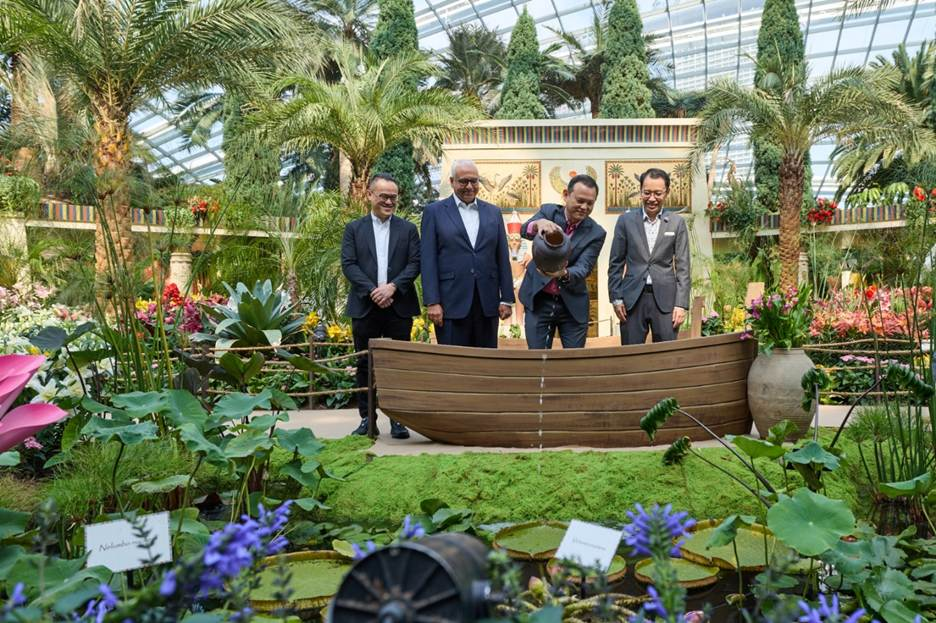
Running until 27 September 2026 at Flower Dome, Lilytopia features more than 7,000 lilies across 46 species and varieties. The display includes fragrant garden lilies in a wide range of colours, the sacred Egyptian blue waterlily and giant Victoria waterlilies.
Presented in collaboration with the Embassy of the Arab Republic of Egypt in Singapore, the floral display also marks 60 years of diplomatic relations between Singapore and Egypt. Acting Minister-in-charge of Muslim Affairs and Senior Minister of State for Defence Mr Zaqy Mohamad launched Lilytopia.
At the centre of the display is Gardens by the Bay’s interpretation of a formal ancient Egyptian garden. Traditionally, such gardens were often enclosed within rectangular walls and featured a central pool containing fish and aquatic plants. Lilytopia recreates this setting with a pond inspired by the Nile, whose waters supported agriculture, communities and gardens amid Egypt’s otherwise arid landscape.
The pond features plants that share the lily name, including the Egyptian blue waterlily, or Nymphaea caerulea. Closely associated with ancient Egyptian garden pools, the flower closes at night and reopens with the morning sun. This natural cycle contributed to its association with creation and rebirth, while its image appeared frequently in ancient Egyptian art, temple offerings and tomb furnishings.
Giant waterlilies Victoria amazonica and Victoria cruziana are also making their debut in a Flower Dome floral display. Native to South America and among the largest members of the waterlily family, the plants were grown from seed by Gardens by the Bay’s research team over the past 18 months.
More than 40 varieties of garden lilies add colour and fragrance to the display. Among the debut cultivars are Lilium Tiny Massive, a compact Asiatic lily with yellow petals and dark centres; Lilium Tropical Dragon, which features narrow lime green petals edged and streaked with vivid pink; and Lilium White Triumph, known for its large white flowers, elegant fragrance and dark green foliage.
Plants associated with Egypt’s landscapes and daily life also feature throughout the garden, including ginger, pomegranate and papyrus. In ancient times, papyrus stems were processed into writing material by cutting the soft inner pith into strips, arranging them in layers, pressing and drying them. The plant’s name is also the origin of the word paper.
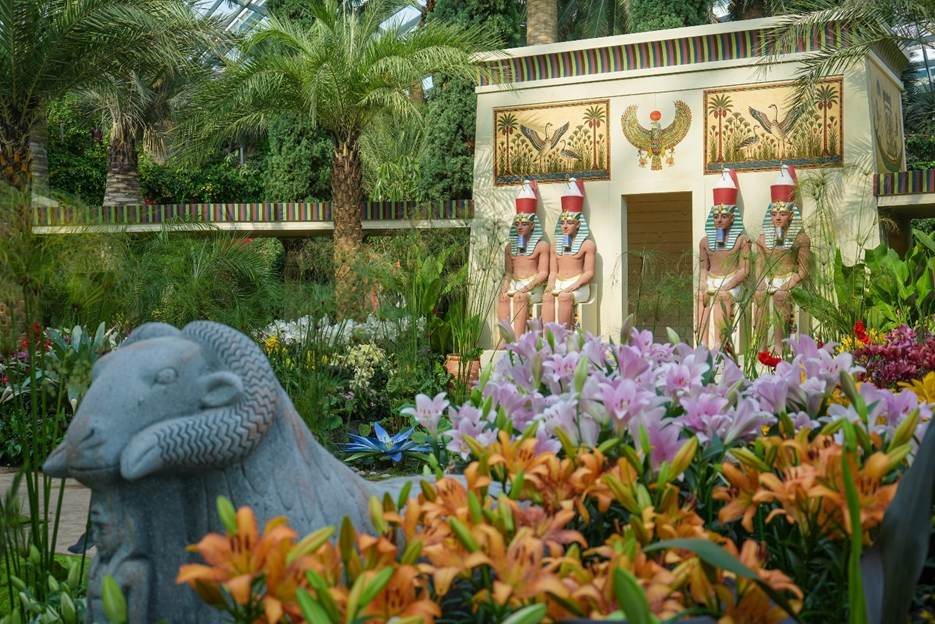
The floral display is framed by architecture and monuments inspired by some of Ancient Egypt’s most recognisable landmarks. A 4.5-metre-tall façade draws inspiration from the Great Temple of Abu Simbel in southern Egypt and recreates the four colossal seated statues of King Ramesses II found at the original temple, which he commissioned around 1264 BC.
Colourful hieroglyphs across the walls and columns take inspiration from the Temple of Hathor at Dendera, one of Egypt’s best preserved temple complexes. Its surviving painted carvings and plant motifs provide a glimpse into the vivid colours that once decorated ancient Egyptian monuments.
Visitors will also encounter towering representations of Egyptian deities including Hathor, goddess of music, joy and motherhood; Ra, the sun god; and Thoth, god of the moon, wisdom and writing.
Other elements include architecture inspired by the Temple of Edfu, a solar barque representing the vessel believed to carry the sun god Ra across the sky, and traditional irrigation tools including the shaduf and Archimedes screw.
To mark the opening of Lilytopia, visitors to Flower Dome can also take home a complimentary air plant from 22 to 25 August. The giveaway is limited to one plant per visitor and is available while stocks last.
Lilytopia runs at Gardens by the Bay’s Flower Dome until 27 September 2026, offering visitors an opportunity to experience Ancient Egypt through its flowers, gardens, architecture, mythology and craftsmanship.