
![[Review] Onggii Opens 3rd Outlet at Square 2, Brings Korean Comfort Food like Gomtang and Galbi Jjim to Novena - Alvinology](https://alvinology.com/wp-content/uploads/2026/10/WhatsApp-Image-2026-10-28-at-1.51.05-AM-110x110.jpeg "[Review] Onggii Opens 3rd Outlet at Square 2, Brings Korean Comfort Food like Gomtang and Galbi Jjim to Novena")
![[Review] Osteria Mozza's New Home at ION Orchard Brings a Different Take on Pizza, Pasta and Italian Comfort Food - Alvinology](https://alvinology.com/wp-content/uploads/2026/10/osteria-mozza-11-110x110.jpg "[Review] Osteria Mozza's New Home at ION Orchard Brings a Different Take on Pizza, Pasta and Italian Comfort Food")
![[Review] HONOR X9e Pro Lands in Singapore with an 11,000mAh Battery That Doubles as a Power Bank - Alvinology](https://alvinology.com/wp-content/uploads/2026/10/honor-9xe-purple-06-110x110.jpg "[Review] HONOR X9e Pro Lands in Singapore with an 11,000mAh Battery That Doubles as a Power Bank")

Meta has introduced Muse Spark 1.1, the latest multimodal reasoning model from Meta Superintelligence Labs, marking a significant upgrade over its predecessor. Designed for agentic AI tasks, the new model brings major improvements in tool and computer use, coding, multimodal understanding, and long context handling, while moving Meta closer to its vision of personal superintelligence.
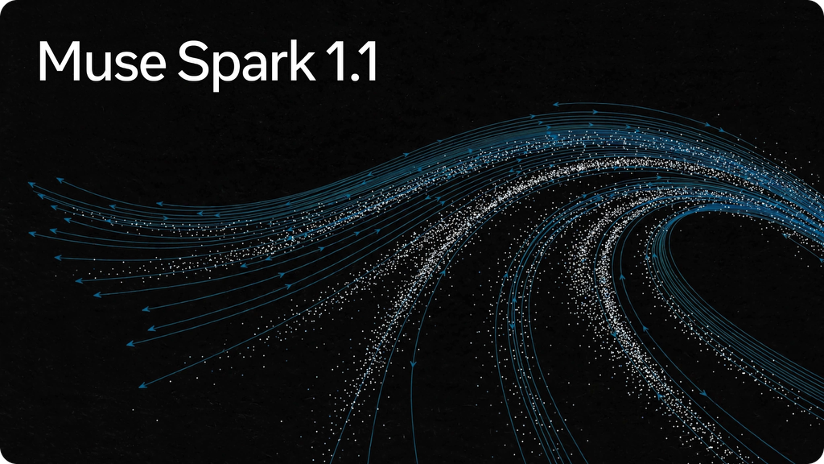
The launch follows this week’s debut of Muse Image and expands Meta’s growing AI ecosystem with models built to help users accomplish goals, create content, strengthen relationships, and complete tasks across a wide range of applications and services.
Muse Spark 1.1 is now available in “Thinking” mode through the Meta AI app and on meta.ai. Alongside the release, Meta has also launched a public preview of the new Meta Model API, allowing developers to begin building applications using the model.
One of the biggest advancements in Muse Spark 1.1 is its ability to handle complex personal agent workflows that require planning and coordination across multiple external apps and services. The model can generalise to new native tools, MCP servers, and custom skills without prior examples, making it more adaptable to different environments.
Meta says the model completes large scale projects significantly faster than Muse Spark by orchestrating multi agent systems that optimise overall execution time. Acting as the primary agent, it can gather context, develop a plan, and assign work to parallel subagents. When operating as a subagent, it understands its assigned responsibilities, makes effective use of available tools, and knows when to escalate tasks back to the main agent.
The model also supports an extensive context window of one million tokens, allowing it to retain important information across long running sessions. It can recall earlier actions, retrieve information from previous work, and intelligently compress context while preserving key details needed for future tasks.
Muse Spark 1.1 has also been enhanced for computer use workflows involving multiple applications where information changes dynamically. It maintains awareness throughout lengthy sessions, adapts to evolving requirements, and navigates unfamiliar software interfaces with minimal user input.
Rather than relying solely on interface interactions, the model determines when automation is the faster option. It can generate scripts when appropriate, interact directly with user interfaces when simpler, and execute groups of actions in batches to improve efficiency.
Coding capabilities have also received a substantial boost. Muse Spark 1.1 is designed to work with large and complex codebases, enabling it to diagnose and resolve difficult software bugs, implement new enterprise features, and perform large scale code migrations. Meta says it also demonstrates significant improvements in building web applications and completing end to end question answering tasks compared with the original Muse Spark.
The model has been trained to work smoothly across different coding environments and agentic development workflows. It supports planning mode, goal conditioning, subagent delegation, and context compaction, making it suitable for modern AI assisted software development.
According to Meta, developers and researchers across the company are already using Muse Spark 1.1 to accelerate coding and research workflows. On Meta’s Internal Coding Bench, the new model delivers notable improvements over Muse Spark and performs competitively against leading AI models.
Beyond software development, Muse Spark 1.1 introduces stronger multimodal capabilities, combining perception, reasoning, and tool use. It can analyse images, video, and audio, generate visual to code outputs, produce highly detailed image and video captions, and execute multimodal workflows that combine perception with action.
These capabilities enable the model to inspect visual and audio information, retain important details throughout long workflows, and use that information while interacting with computers on behalf of users.
Meta said Muse Spark 1.1 underwent extensive safety testing before deployment under its Advanced AI Scaling Framework. Evaluations covering chemical and biological risks, cybersecurity, and loss of control concluded that the model operates within established safety thresholds.
The company also reports that Muse Spark 1.1 demonstrates improved resistance against jailbreak attempts, prompt injection attacks, developer prompt exploits, and untrusted data. Meta says the model also achieves lower hallucination rates, reduced sycophancy, and stronger overall robustness.
With the public preview of the Meta Model API now available, developers can begin integrating Muse Spark 1.1 into their own applications. Meta says early partners have highlighted the model’s combination of long context handling, coding performance, and reasoning abilities as a strong foundation for building large scale AI agents.
Meta added that Muse Spark 1.1 reflects the company’s ongoing research momentum, with even more advanced AI models currently in development.