

![[Review] Onggii Opens 3rd Outlet at Square 2, Brings Korean Comfort Food like Gomtang and Galbi Jjim to Novena - Alvinology](https://alvinology.com/wp-content/uploads/2026/10/WhatsApp-Image-2026-10-28-at-1.51.05-AM-110x110.jpeg "[Review] Onggii Opens 3rd Outlet at Square 2, Brings Korean Comfort Food like Gomtang and Galbi Jjim to Novena")
![[Review] Osteria Mozza's New Home at ION Orchard Brings a Different Take on Pizza, Pasta and Italian Comfort Food - Alvinology](https://alvinology.com/wp-content/uploads/2026/10/osteria-mozza-11-110x110.jpg "[Review] Osteria Mozza's New Home at ION Orchard Brings a Different Take on Pizza, Pasta and Italian Comfort Food")
![[Review] HONOR X9e Pro Lands in Singapore with an 11,000mAh Battery That Doubles as a Power Bank - Alvinology](https://alvinology.com/wp-content/uploads/2026/10/honor-9xe-purple-06-110x110.jpg "[Review] HONOR X9e Pro Lands in Singapore with an 11,000mAh Battery That Doubles as a Power Bank")

Something has been quietly changing on Singapore’s cycling paths. More office workers are arriving at their desks without needing a shower first. Delivery riders are doing different maths on their monthly outgoings. And people who spent years assuming ebikes were a niche hobby are taking a second look.
It’s not one thing driving this. It’s several — coming together at roughly the same time. Transport costs have climbed to levels that make alternatives genuinely attractive. LTA regulations have tidied up the micro-mobility landscape in ways that leave the compliant ebike looking more stable than most other options. And the quality of what’s actually available in the Singapore market has improved to the point where the day-to-day experience is hard to fault.
Here’s what’s behind the shift, and what’s worth knowing before you start shopping.
The Cost Question
Owning a car in Singapore has always been expensive. But the past year pushed things further.
Category A COE premiums — the certificate you need just to register a small car or EV — hit a record S$128,105 in October 2025. They’ve come off that peak but remain stubbornly high: the latest May 2026 exercise closed at S$102,501, with an earlier round in the same month closing at S$124,790. Either way, the permission slip alone costs more than many Singaporeans earn in a year, before a single dollar goes toward the actual vehicle.
Motorbikes used to be the sensible middle ground. That gap has narrowed too, with Category D premiums rising through 2025 alongside petrol, road tax, and insurance costs that don’t sit still either.
Against that backdrop, a new LTA-approved ebike becomes a different kind of conversation — not just cheaper transport, but a legitimate rethink of what getting around actually needs to cost.
What the 2026 LTA Regulations Actually Changed
The regulatory picture has clarified quite a bit, and it’s worth understanding what shifted.
Non-UL2272 e-scooters are fully out. From June 2026, even keeping one at home is an offence — not just riding it. A lot of people who were previously riding e-scooters are now looking for something compliant, and many of them are ending up at ebike retailers.
PMA rules tightened. Mobility scooters now require a Certificate of Medical Need for riders, with enforcement specifically targeting people who are visibly able-bodied. Another grey zone, closed.
For ebikes — the rules haven’t changed much, and that’s the point. A legal PAB needs a 250W motor cap, 25 km/h pedal-assist cutoff, EN15194 certification, an LTA orange seal, and a rear registration plate. These requirements have been consistent for years. While other categories have faced waves of rule changes, the compliant ebike has stayed on solid ground throughout. That regulatory stability is genuinely reassuring if you’re thinking about spending real money on one.
One admin step to plan for: the Mandatory Theory Test (MTT) for PAB riders — a one-time online test conducted via Singapore Polytechnic’s PACE Academy at pace.sp.edu.sg. It costs S$10.90, covers the Active Mobility Act, where you can ride, and safe path etiquette, and consists of 40 multiple-choice questions to be completed in 40 minutes. Once passed, the digital certificate has no expiry date. Most people find it manageable with an hour or two of preparation using LTA’s published study materials.
What to Look For When You’re Shopping
The local market has grown enough that there’s real variation between models. A few things are worth getting clear on before you commit.
The orange seal is everything. If the bike doesn’t carry LTA’s orange seal, it cannot legally go on a cycling path or road in Singapore. Some sellers list models that are “similar to” an approved bike — that’s not the same as being on the registered PAB list. Check the list. Don’t assume.
Range on paper versus range in practice. Manufacturers quote ideal conditions. Real-world Singapore commuting — stops, starts, humidity, rider weight — typically lands you at 60 to 70 percent of that figure. If your commute is 12 to 15 km each way, a bike rated at 70 to 80 km gives you room to breathe without needing to charge at the office.
Battery and charging. Most bikes charge fully overnight — four to six hours on a standard socket. Worth asking the retailer whether the charger is included, since not all packages come with one.
After-sales matters more than people expect. An ebike has moving parts and a battery that will eventually need attention. Buying from a retailer with a physical service location in Singapore is not a small thing — it means you have somewhere to go when something needs sorting, rather than trying to ship a bike or hunt down a mechanic who knows your model.
Eko Life: Where to Start Looking
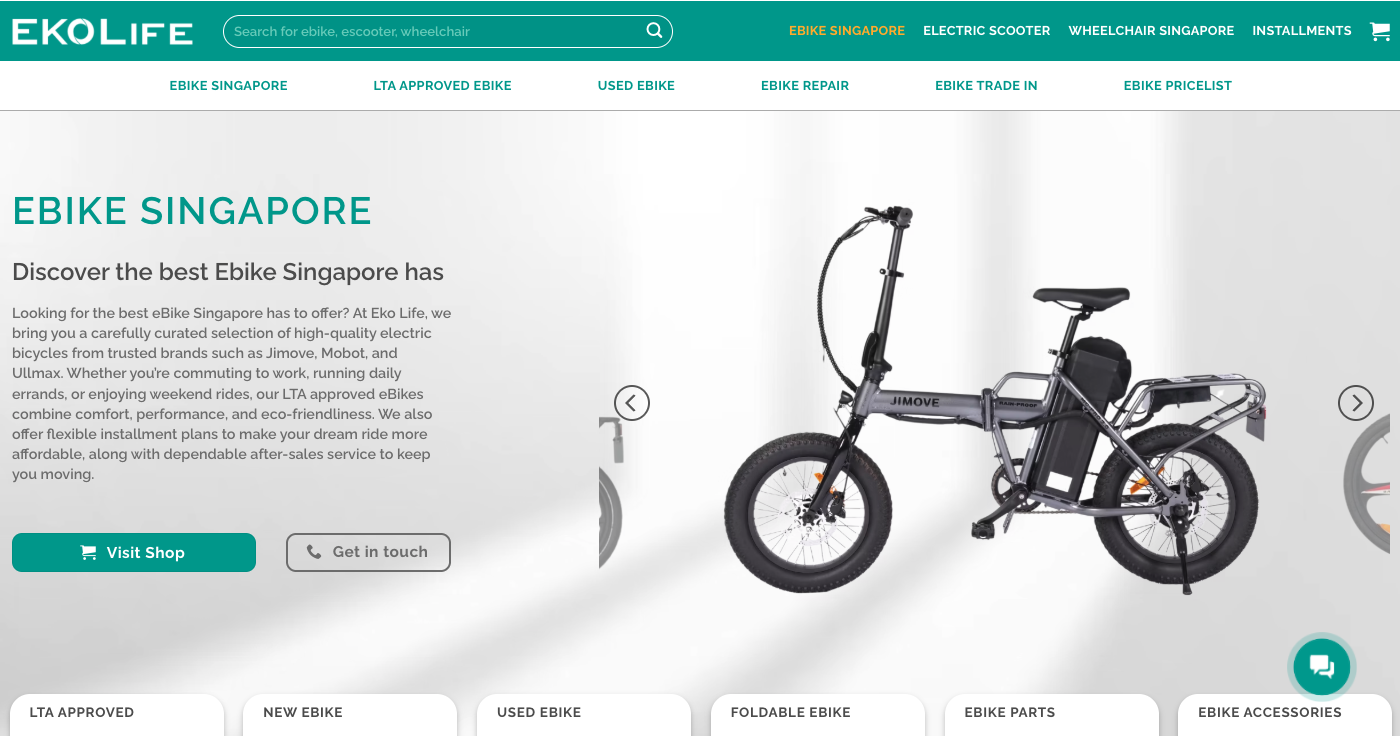
For anyone who wants to skip the research rabbit hole and start with a curated range of compliant bikes, Eko Life is a solid first stop. They carry a selection of ebike Singapore buyers keep coming back to — LTA-approved models from Jimove, Drive, and Ullmax, with physical showrooms at Tai Seng and Canberra.
Everything in their range carries the orange seal — so the compliance question is answered before you’ve even asked it. New ebikes start from S$1,599, and their 0% instalment plans mean you can ride away the same day with nothing down.
If you’re on the fence, going in person and actually riding something is the fastest way to decide. Both locations carry stock on the floor.
The Bigger Picture: Where Singapore Is Heading by 2030
The case for an ebike in 2026 isn’t just about what’s happening now — it’s about where the infrastructure is going.
LTA’s Islandwide Cycling Network programme, backed by S$1 billion in government spending, is expanding Singapore’s cycling path network to around 1,320 km by 2030. That’s nearly double what exists today. When it’s complete, 8 in 10 HDB residents will be within minutes of a cycling path, with connections running from homes to MRT stations, bus interchanges, shopping centres, and schools.
The North-South Corridor — 21.5 km of dedicated cycling trunk route from the northern towns all the way into the city centre — is one of the bigger pieces of that puzzle, opening up longer commutes that most people wouldn’t have considered doing on two wheels before.
What this means practically is that the usefulness of an ebike is set to grow as the decade progresses. The paths being completed now are designed for exactly the kind of riding an LTA-approved ebike does best. Buying one in 2026 is less a bet on the present and more a reasonable read on where things are going.
Is It Right for You?
Honestly, it depends on your route and your situation. The ebike case is strongest if your regular commute runs along cycling paths or roads where PABs are allowed, if you want to cut a meaningful chunk off your monthly transport spend over the next year or two, and if you have somewhere at home to store a bike.
It’s a harder sell if your route involves expressways — ebikes aren’t permitted there — or if carrying heavy loads is a regular part of your day.
The Mandatory Theory Test (MTT) for PAB riders can be done online at Singapore Polytechnic’s PACE Academy — it costs S$10.90 and most people clear it comfortably with a bit of preparation.
The best thing to do, if you’re genuinely considering it, is go and ride one. Head to Eko Life at Tai Seng or Canberra — their ebike Singapore showroom has stock on the floor — spend twenty minutes on the road, and you’ll know whether it works for you better than any amount of reading will tell you.
Looking to explore LTA-approved ebikes in Singapore? Browse the full ebike Singapore range at Eko Life, with showrooms at Tai Seng and Canberra.