

![[Review] Onggii Opens 3rd Outlet at Square 2, Brings Korean Comfort Food like Gomtang and Galbi Jjim to Novena - Alvinology](https://alvinology.com/wp-content/uploads/2026/10/WhatsApp-Image-2026-10-28-at-1.51.05-AM-110x110.jpeg "[Review] Onggii Opens 3rd Outlet at Square 2, Brings Korean Comfort Food like Gomtang and Galbi Jjim to Novena")

![[Review] Osteria Mozza's New Home at ION Orchard Brings a Different Take on Pizza, Pasta and Italian Comfort Food - Alvinology](https://alvinology.com/wp-content/uploads/2026/10/osteria-mozza-11-110x110.jpg "[Review] Osteria Mozza's New Home at ION Orchard Brings a Different Take on Pizza, Pasta and Italian Comfort Food")
![[Review] HONOR X9e Pro Lands in Singapore with an 11,000mAh Battery That Doubles as a Power Bank - Alvinology](https://alvinology.com/wp-content/uploads/2026/10/honor-9xe-purple-06-110x110.jpg "[Review] HONOR X9e Pro Lands in Singapore with an 11,000mAh Battery That Doubles as a Power Bank")

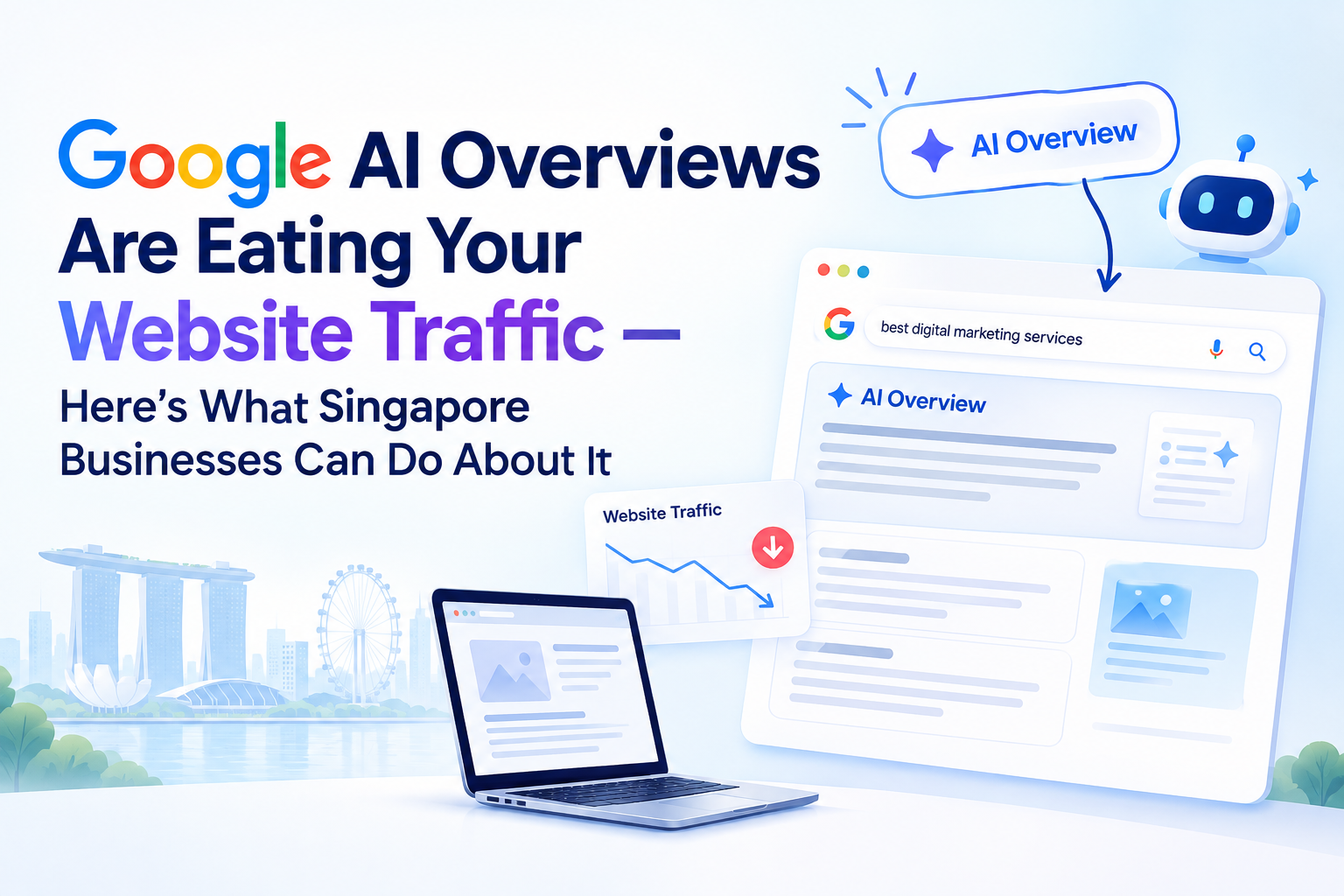
A business owner checks her analytics and notices something odd. Her rankings look fine, sometimes even better than before. Her actual website visits, though, keep quietly dropping.
This isn’t a glitch. It’s a pattern showing up across countless Singapore websites right now.
Google’s AI Overviews now answer many questions directly on the results page. A visitor gets their answer without ever clicking through to a website. The click that used to happen simply doesn’t happen anymore.
What’s Actually Happening to Search Traffic Right Now
AI Overviews summarise information from several sources into one answer. That summary sits right at the top of the results page, above every organic listing.
For simple, factual questions, this often removes the need to click at all. Someone asking “what are common signs of a slow drain” gets an answer instantly, no website visit required.
This shift is often called a “zero-click search.” The search happens, the question gets answered, but no single website receives credit for it.
The scale of this shift varies by industry and query type. Some businesses barely notice a difference. Others see a meaningful chunk of their informational traffic disappear within months.
Why This Changes the Rules for Website Traffic
Ranking first used to guarantee a reasonable share of clicks. That relationship has weakened considerably with AI Overviews sitting above the fold.
A page can rank well and still lose traffic, simply because Google’s own summary answered the question first. This is a different problem from ranking badly, and it needs a different response.
Businesses that only track keyword rankings can miss this shift entirely. Rankings can look stable while actual visits quietly decline underneath them.
This is why traffic data now matters more than position alone. A page holding steady at position two, but losing clicks month over month, tells a very specific story.
What This Means for Singapore Businesses Specifically
Singapore’s market is small and search-heavy, with many businesses competing for the same local queries. AI Overviews affect informational searches more than highly specific local ones.
A search like “best electrician near Bukit Timah” still tends to favour direct listings and maps results. A search like “how often should aircon be serviced” is far more likely to get an AI summary instead.
This means content strategy now needs to separate these two types of queries. They no longer behave the same way, even within the same industry.
Retail and ecommerce businesses face a related version of this problem. A shopper researching “how to choose a mattress firmness” may get a full answer from an AI Overview. They then search separately for where to actually buy one. The research phase and the buying phase are splitting apart.
A Closer Look at Which Queries Are Most Affected
Not every search behaves the same way under AI Overviews. Purely definitional questions, like “what does PSI mean for tyres,” get absorbed almost completely.
Questions requiring comparison, opinion, or recent pricing tend to hold up better. An AI Overview struggles to fully answer “which aircon brand lasts longest in Singapore’s climate” with total confidence.
Transactional searches, where someone clearly intends to buy or book something, remain far less affected. Google still needs to send that person somewhere to complete the action.
Understanding which of your own keywords fall into each category is the first real step. Not every drop in traffic has the same cause, or the same fix.
What Businesses Are Getting Wrong in Response
A common mistake is panicking and abandoning content strategy altogether. Some businesses stop publishing entirely, assuming nothing will get clicked anyway.
This overcorrects badly. Plenty of searches still send real, valuable traffic to websites, particularly transactional and highly specific ones.
Another common mistake is trying to write content specifically to “beat” AI Overviews through tricks or formatting hacks. Most of these attempts get outdated within weeks, as the systems themselves keep changing.
A steadier approach focuses on genuine depth and specificity, rather than gaming any particular system. This tends to hold up regardless of how AI Overviews evolve further.
How to Adapt Content So It Still Gets Seen
Content built purely to rank for broad, informational keywords is most exposed to this shift. Very specific, practical, or locally focused content tends to hold up better.
Answering a question thoroughly, with detail an AI summary can’t fully capture, still has value. A short paragraph answering “what is X” gets summarised easily. A detailed guide with real examples is harder to fully replace.
Structuring content so a business’s own expertise clearly still matters. This is a core part of what any competent SEO service should be adjusting for right now.
Original data, case studies, and first-hand examples are harder for an AI summary to replicate convincingly. Generic advice, repeated across a thousand similar pages, is exactly what gets summarised and skipped.
When It Makes Sense to Bring in Outside Help
Some businesses can make these adjustments internally, especially with a small, focused website. Others find the shift harder to track without dedicated attention.
Working with an experienced AI SEO agency in Singapore can help separate real losses from other issues. It shows which content is genuinely losing traffic to AI Overviews. It can also show which losses trace back to unrelated issues instead, like outdated pages or slow load times.
The right call usually depends on how much traffic is actually at stake. A site losing a small fraction of visits may not need outside help immediately.
For businesses with a large content library, this kind of audit takes real time to do properly. Reviewing hundreds of pages manually, one by one, is rarely realistic without dedicated resources.
This is often where outside expertise pays for itself quickly. An experienced team can usually spot patterns across a site far faster than an internal team juggling other responsibilities.
A Longer-Term Way to Think About This
AI Overviews are unlikely to disappear, and they will likely keep expanding into more query types over time. Treating this as a temporary dip rarely serves a business well.
A more useful mindset treats organic traffic as one channel among several, rather than the only one worth tracking. Email lists, direct visits, and repeat customers matter more when a single click can no longer be guaranteed.
Businesses that diversify how customers find and return to them tend to weather this shift more comfortably. Search traffic remains valuable, just less reliably guaranteed than it once was.
Practical Steps Worth Taking Now
Start by checking which of your pages rank well but receive fewer clicks than expected. This gap often points directly to AI Overview competition.
Review whether your content answers a question briefly or answers it with genuine depth. Depth tends to hold its ground better against a short AI summary.
Look at your local, specific searches separately from broad informational ones. The strategy for each is no longer quite the same.
- Check click-through rates against rankings for your top pages.
- Identify which queries now trigger an AI Overview above your listing.
- Strengthen content where an AI summary can’t easily replace your detail.
- Keep local, specific pages sharp, since these are less affected for now.
None of these steps requires abandoning SEO altogether. They require adjusting to a search environment that no longer rewards ranking alone. Traffic still exists for businesses willing to adapt to it.