

![[Review] Onggii Opens 3rd Outlet at Square 2, Brings Korean Comfort Food like Gomtang and Galbi Jjim to Novena - Alvinology](https://alvinology.com/wp-content/uploads/2026/10/WhatsApp-Image-2026-10-28-at-1.51.05-AM-110x110.jpeg "[Review] Onggii Opens 3rd Outlet at Square 2, Brings Korean Comfort Food like Gomtang and Galbi Jjim to Novena")

![[Review] Osteria Mozza's New Home at ION Orchard Brings a Different Take on Pizza, Pasta and Italian Comfort Food - Alvinology](https://alvinology.com/wp-content/uploads/2026/10/osteria-mozza-11-110x110.jpg "[Review] Osteria Mozza's New Home at ION Orchard Brings a Different Take on Pizza, Pasta and Italian Comfort Food")

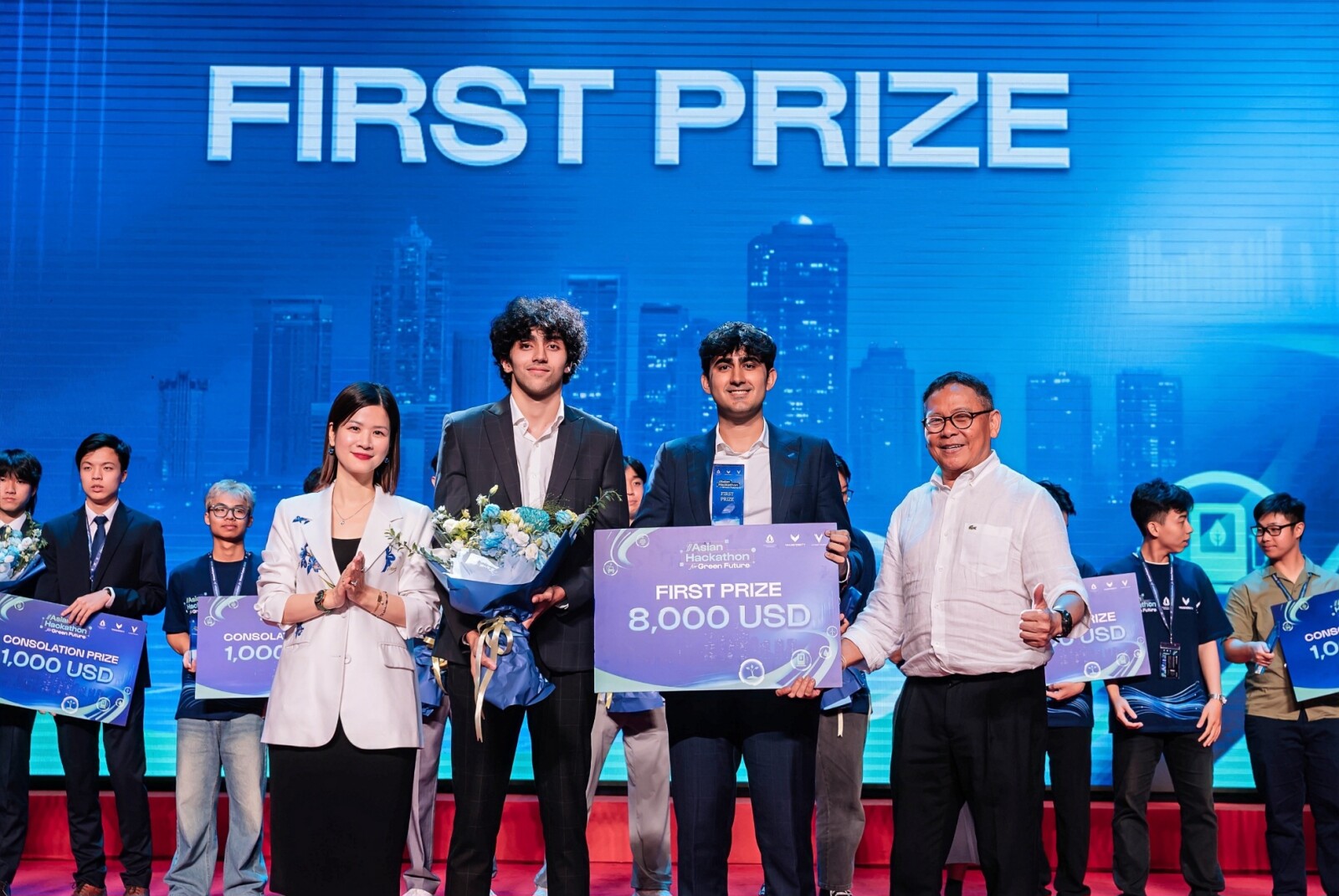
The competition was jointly organized by three not-for-profit entities under Vingroup: the “For Green Future” Foundation, VinUniversity, and the Vingroup Young Technology Talent Club (VinTechTalent). It is the first pan-Asian environmental hackathon exclusively for undergraduate and master’s students to be held in Vietnam. The Final Round and Awards Ceremony took place on July 4 at VinUniversity, Hanoi.
With the project titled “An Urban Simulation Platform for Low-Carbon Infrastructure,” Team Helios won the First Prize, worth USD 8,000. The team’s solution addresses a critical challenge facing many cities today: how to determine whether a green infrastructure project will truly be effective before committing significant resources to its implementation.
The team developed a district-level urban simulation platform that enables users to test options such as EV charging stations, public transportation, solar energy, and climate-resilient infrastructure, while assessing their expected impacts on travel behavior, emissions, costs, and the power grid. The solution helps city authorities identify projects worth investing in, avoid wasting resources on ineffective initiatives, and accelerate the transition to low-carbon cities.
The Second Prize, worth USD 5,000, was awarded to Team VFluxion, comprising four participants, Nguyen The Anh, Vu The Vinh, Tran Hung Vi, and Do Thi Nhu Y, from the University of Information Technology, Vietnam National University Ho Chi Minh City, Vietnam.
VFluxion’s solution addresses an increasingly important need in the transition to green mobility: how to effectively connect and coordinate electric vehicles with urban energy systems.
The team proposed a platform that coordinates bidirectional charging and discharging, enabling electric vehicles not only to consume energy but also to serve as distributed energy storage resources that can help balance electricity demand when needed. The solution aims to optimize energy use, enhance power grid stability, reduce the need to deploy high-emission backup power sources, and protect battery longevity.
Two Third Prizes, each worth USD 3,000, were awarded to two teams from Vietnam: Future Greener and ALT F4.
Team Future Greener, comprising Nguyen Nguyen Tam Nhu, Truong Dong Hung, Pham Ho Kim Ngan, and Bui Hoai Ngoc from UEH.ISB Honours College, University of Economics Ho Chi Minh City, and FPT University’s Ho Chi Minh City campus, developed a project addressing the challenge of managing the life cycle of electric vehicle batteries amid the rapid growth of electric mobility, which brings with it the risk of used batteries being stored, discarded, or handled unsafely.
The platform tracks battery information throughout its life cycle, supports battery health assessment, and helps determine whether a battery should be repurposed or sent for recycling. The solution aims to reduce environmental risks from discarded batteries, increase transparency in the used EV market, and promote a circular economy in the battery industry.
Team ALT F4, comprising Nguyen Tuan Minh, Nguyen Thanh Vinh, and Tran Phi Anh Nhat from the University of Science, Vietnam National University Hanoi, British University Vietnam (BUV), and Hanoi University of Science and Technology, won a Third Prize for its early warning system for saltwater intrusion.
The system monitors water conditions in estuarine areas, forecasts the risk of saltwater intrusion 24 to 72 hours in advance, and sends alerts in Vietnamese directly to the phones of farmers and local officials. This early warning window can enable timely action to close sluice gates, preserve freshwater supplies, and adjust irrigation practices, thereby reducing crop losses, protecting farmers’ livelihoods, and strengthening resilience to climate change.
The Organizing Committee also awarded five Consolation Prizes, each worth USD 1,000, to Project Gaia from Vietnam, AVERTIX from India, ReRootSG from Singapore, Forust from Hong Kong, China, and Seekers from India.
To reach the Final Round, the 30 finalist teams underwent a selection and training journey lasting nearly three months. From 439 teams that entered the Preliminary Round with project proposals and introductory videos, the Top 30 teams advanced to a month-long online training program with multidisciplinary experts to sharpen their problem-solving approaches and prepare for the final challenge.
At VinUniversity, the finalist teams took part in an intensive 36-hour hackathon, during which they analyzed real-world challenges, developed solutions, built functional prototypes, and refined their final presentations under the guidance of expert mentors from Vingroup’s technology companies.
Reflecting on the competition’s outcome, Dr. Thai-Ha Le, Managing Director of the “For Green Future” Foundation, Vingroup, said: “What makes us proud is that the Asian Hackathon for Green Future 2026 has shown that Vietnam can truly become a regional hub for Asia’s young talent in the journey of innovation for sustainable development. Here, cross-border ideas are not only shared, but also tested, refined, and transformed into practical solutions capable of creating lasting value for communities.”
From energy and transportation to climate, water resources, and agriculture, the environmental challenges facing Asia increasingly transcend national borders and demand regional collaboration. By bringing together young talent from diverse countries and disciplines, the Asian Hackathon for Green Future aims to foster a regional space for collaboration, where knowledge, technology, and diverse perspectives can converge, complement one another, and develop into solutions with the potential to create real-world impact.
Following the success of its inaugural edition, the competition will return for a second season in 2027 with an expanded scale and geographical reach, aiming to attract more young talent from across Asia and other regions of the world to jointly develop solutions for a green and sustainable future.
Hashtag: #Vingroup
The issuer is solely responsible for the content of this announcement.